Designing Safer Cities at Night
I spend a lot of time exploring cities at night. It’s only when I’m coordinating with friends or family—especially women—that I’m reminded of my relative male privilege in how differently that experience is navigated according to gender. What feels spontaneous for me often involves layers of planning: choosing routes, timing journeys, thinking about lighting, transport and more. It’s not just movement—it’s constant risk management.
This asymmetry isn’t anecdotal. It is well documented across cities globally. In the UK, 97% of young women report experiencing sexual harassment in public spaces, while in Ireland over half feel unsafe using public transport after dark. Research also shows that women are less likely to use public space freely, particularly at night. These patterns—and the ways women adapt their behaviour—are explored in the Women After Dark series.
What stands out is the invisible labour: vigilance, route planning, behavioural adjustments. Different lives, but a shared need to constantly assess risk in environments that were not designed with them in mind.
This is not just a social issue. It is a design—and systems—issue.
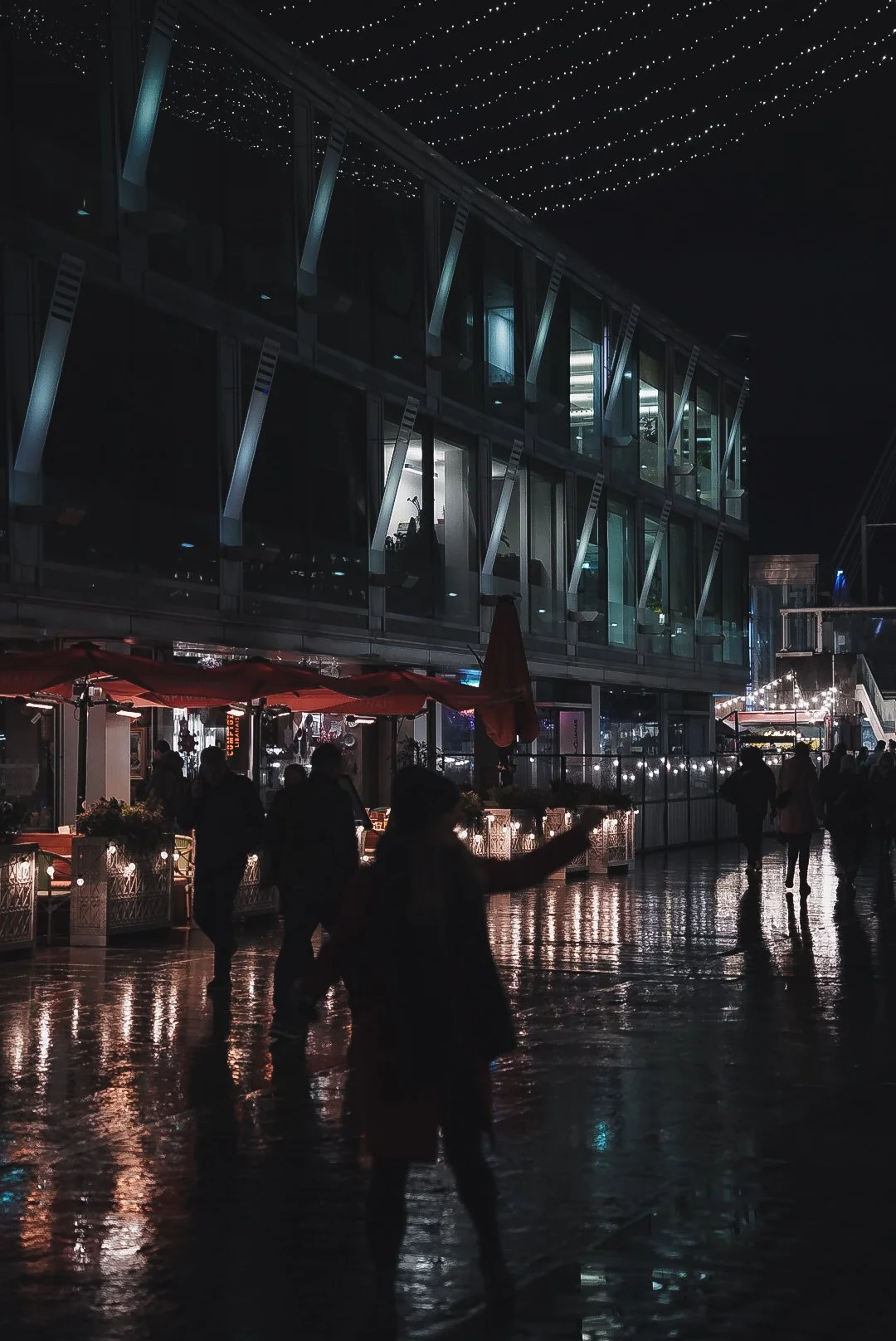
A sense of safety is fundamental to quality of life. When the built environment feels unsafe, it creates both mental and physical stress, limiting how people move through and experience the city. Around one-third of women report feeling unsafe in public spaces at night, and this has real consequences: longer routes home, avoided journeys, or opting out of activities altogether.
Urban environments are not neutral. Poor lighting, obstructed sightlines, isolated underpasses, and infrequent transport create barriers to movement—particularly after dark. Even the structure of transport systems can disadvantage those making multiple, chained journeys—patterns more common among women—rather than the linear commute they are often designed around.
Crucially, safety is often misunderstood as a policing issue. But there is an important distinction between security—responding to crime—and safety—creating environments where people feel able to move, participate, and access opportunity. Cities have limited control over crime itself, but they have significant influence over the conditions that shape safety: design, transport, maintenance, and governance (see SafetiPin’s Safe Women, Safer Cities).
The consequence is not only fear, but constraint. When safety is uncertain, mobility is reduced—and with it, access to work, services, and opportunity. Poor and unsafe transport alone can reduce women’s participation in the labour market by up to 16.5%, while safety concerns lead many to turn down jobs or incur higher costs to travel safely. But safety should not require an economic justification. It is a baseline condition of a well-functioning city—the economic argument simply reinforces the urgency.
Designing safer cities means embedding safety into the fabric of urban environments. That starts with visibility—well-lit, legible spaces with clear lines of sight. It requires active streets, where mixed uses and footfall create natural surveillance. It means transport systems that are reliable, frequent, and designed for real patterns of movement—not idealised ones.
We know what works. Thoughtful interventions—from better lighting design and active street frontages, to transparent transit spaces that improve visibility and natural surveillance—have been shown to significantly improve perceptions of safety and actual use of space.
A city that is safe for women is a city that works for everyone. A city that isn’t is not just unequal—it is poorly designed.
